
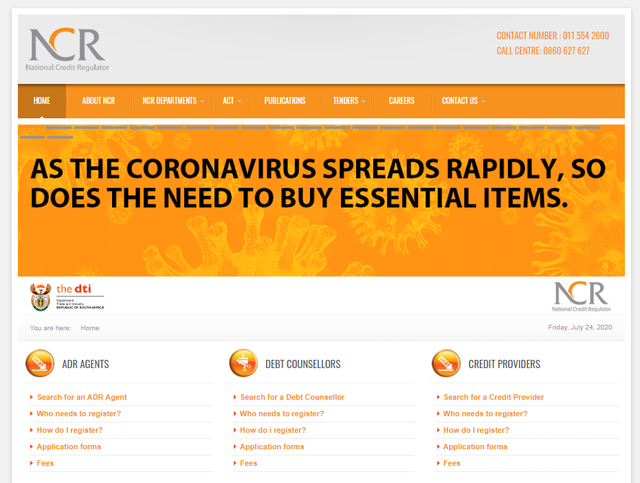

The National Credit Regulator, usually called the NCR, regulates South Africa’s consumer-credit industry under the National Credit Act. For someone under debt review, the most useful tasks are often checking a debt counsellor’s registration, identifying a payment agency or preparing a complaint. This page explains how to take those steps and use current official contact details.
The NCR is a regulator. It is not your debt counsellor, a credit bureau or the agency allocating your monthly payment. Understanding that distinction helps you send the right question to the right organisation.
What does the National Credit Regulator do?
The NCR’s work includes registration and oversight of regulated participants, investigation of complaints and enforcement of the National Credit Act. Its website also provides registers, consumer information and guidance for the industry. The official Act-download page is a starting point for legislation; older articles should be checked against amendments and current guidance.
Debt counsellors, credit providers, credit bureaux and payment distribution agencies have different roles and registration requirements. An NCR number associated with one role does not automatically authorise every service advertised by a business. Insurance authorisation, for example, should not be inferred merely from credit-industry registration.
The NCR also differs from the National Consumer Tribunal, which deals with matters within its own statutory powers. If your issue needs a Tribunal application or a court remedy, a general complaint email is not a substitute for that procedure. Obtain advice on the route and deadlines that apply to your case.
How do I check a debt counsellor’s registration?
Ask for the full name of the individual counsellor and their NCRDC number. A company brand alone may not identify the professional responsible for your file. Use the official NCR register of registrants and choose the relevant registration category.
Compare the name, number and status with the information you were given. If the register does not match, contact the NCR for clarification before relying on a claimed registration. Registration status should be checked at the time you act.
Keep a dated copy of the result with your documents. A registration check is useful, but it does not replace reading the proposed service, fees and application documents. It also does not establish that a message using the registered person’s name is authentic.
The DCD directory helps you locate counselling services. Independently verify the named counsellor with the NCR and ask who will be responsible for your case. Our Debt Counselling guide explains the role before you appoint someone.
How do I verify a payment distribution agency?
Use the PDA section of the current register and compare the registered legal name with your payment instructions. A PDA distributes money; a counsellor manages the debt review case. Search results and historical lists may show agencies whose registration has since changed.
The PDA overview explains what to check on a statement. If the query concerns money received or allocated, gather the bank proof and distribution record first. If it concerns changing the repayment plan, involve your counsellor.
Do not accept new bank details merely because a sender includes an NCR registration number. Verify the instruction separately through official contact details. A scammer can copy a real number or logo.
How can I contact the NCR?
The following details were checked against the NCR’s own contact page on 11 October 2026:
- Call centre: 0860 627 627.
- Reception: 011 554 2700.
- General enquiries: info@ncr.org.za.
- Complaints: complaints@ncr.org.za.
- Office: 127 15th Road, Randjespark, Midrand, 1683.
The NCR’s relocation notice states that its former 232 15th Road office closed in July 2025. Check the official site before travelling and ask whether your enquiry can be handled remotely. Do not rely on an older article’s address or registration-specific extension.
This guide does not publish a WhatsApp number because a current official one was not verified. Use the official channels above, and check the website again if a message asks you to use different details.
How do I lodge a complaint with the NCR?
Begin by describing the problem in a short, dated account. Where appropriate, try the responsible provider’s support or complaint route and include its response. Do not delay urgent legal advice while waiting for a routine complaint outcome.
Prepare a useful evidence pack:
- Your contact details and the affected provider’s name and registration number, if known.
- A timeline showing what happened and when you raised it.
- The relevant application, plan or agreement pages.
- Bank proof and statements for a payment issue.
- Copies of correspondence and existing query references.
- A clear statement of the result you are asking for.
The NCR makes Form 29 available for complaints. Follow the current instructions and ask which supporting records are needed. Keep proof of submission and the complaint reference.
An illustrative complaint might say: “The June payment left my bank on 3 June. The agency statement shows no allocation to account ending 1234. I requested a trace on 8 June and attach the response.” That is easier to investigate than “all my money is missing” without records. State facts you can support and separate them from assumptions.
Can the NCR remove my debt review record?
The answer depends on why the record exists and the stage of your case. A complaint does not automatically cancel debt review, remove a court order or make you eligible for new credit. If you have completed the qualifying obligations, read the Clearance Certificate guide.
If you believe the application or status is wrong, obtain the underlying documents and ask for a case-specific assessment. Debt Review Removal explains why informal withdrawal promises and improved income alone should not be treated as automatic exits. Any legal remedy requires verification of its grounds and procedure.
Check the outcome on your credit report and retain the supporting evidence. A free credit check can help you see what is recorded, but it does not itself correct the information or change your legal status.
Frequently asked questions
How do I check my status on NCR?
For a provider’s registration, use the appropriate official register and compare the name and number. For your own debt review case, ask your counsellor for the case records and compare them with your credit report. The public registrant list is not a personal debt-status lookup.
How do I lodge a complaint with NCR?
Use the official complaint route and current Form 29 instructions. Provide a focused timeline, relevant documents and the result you need. Keep the submission and reference for follow-up.
How do I remove debt review from NCR?
Establish whether the issue is lawful completion, an incorrect record or another case-specific problem. Clearance and legal remedies have different requirements. An email asking to cancel is not an automatic removal process.
How can I contact NCR?
The official call centre is 0860 627 627 and general enquiries go to info@ncr.org.za, checked on 11 October 2026. Complaints use complaints@ncr.org.za. Confirm details on the NCR website before sending sensitive documents.
Does registration guarantee the service will be right for me?
No registration check can answer every question about your individual needs. Verify the professional, read the documents and ask about the proposed service and charges. Keep a written record of what you agree to.
This article is general information, not legal or financial advice. Speak to a registered debt counsellor or attorney about your situation.
Find debt counsellors offering National Credit Regulator NCR →